Author: Anne Fouilloux, FAIR2Adapt coordinator, CTO at Lifewatch
There is something uniquely disorienting about attending a major conference during your first week in a new job – especially when you are still representing your old projects and organisation. At the EOSC Symposium 2025 in Brussels, I found myself in exactly this position: freshly arrived at LifeWatch ERIC, yet still carrying the flag for FAIR2Adapt and OSCARS-FIESTA, two projects where Simula, my previous employer, was either a partner or, in the case of FAIR2Adapt, the coordinator.
The historic Le Plaza Hotel provided a grand backdrop for what became three days of intense networking, strategic discussions, and, if I am being honest, a fair amount of confusion about where exactly communities like ours fit within the emerging EOSC Federation.
The Promise of the EOSC Federation
The symposium marked the official transition of the EOSC Federation into its operational phase. There was palpable excitement in the air as the first wave of candidate EOSC Nodes were showcased alongside the EOSC EU Node.
The vision is compelling: a federated European Open Science Cloud where data flows seamlessly across borders, disciplines, and institutions. Where researchers can discover, access, and reuse data regardless of where it originates. Where FAIR principles aren’t just aspirations but operational realities.
When Theory Meets Practice: The Node Question
But here’s where things got interesting for someone coming from the climate change adaptation community.
Throughout the symposium, I kept asking myself—and others—the same question: Where do our Climate Change Adaptation services actually belong?
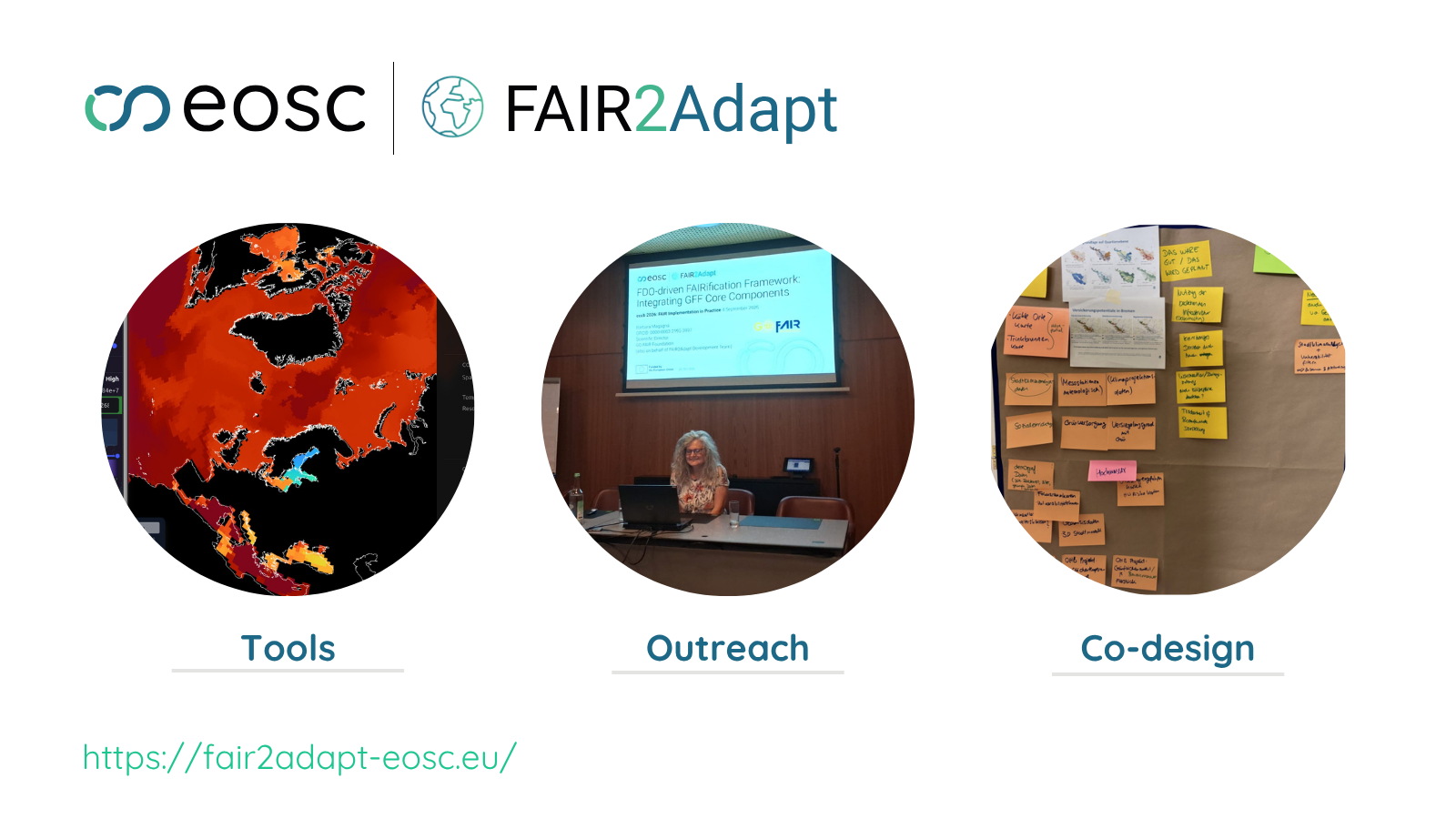
FAIR2Adapt focuses on transforming climate adaptation strategies through FAIR and open data sharing. We work with diverse stakeholders—from city planners in Hamburg developing heat action plans to researchers tracking Arctic radionuclides. Our data needs span climate projections, socio-economic scenarios, biodiversity data, and everything in between. We’re inherently cross-domain.
And therein lies the challenge.
The Newcomer’s Dilemma
What struck me most during the symposium was a growing realisation about where communities like ours actually fit—or rather, how we weren’t quite thought about when the EOSC Federation architecture was designed.
The Climate Change Adaptation community is small. We have little existing anchor to EOSC. And we’re deeply, unavoidably cross-disciplinary. When I talked to representatives from various nodes, I found myself nodding along to everyone’s pitch. Environmental data? Yes, we need that. Biodiversity infrastructure? Absolutely relevant. National nodes with local expertise? Essential for our case studies. Computing resources? Of course.
The thing is: everyone was right. And that’s precisely the challenge.
Climate change adaptation isn’t just an environmental science problem. It’s not just a biodiversity challenge. It’s not just urban planning or public health or economics. It’s all of these simultaneously, with deep interdependencies that don’t respect disciplinary boundaries.
For a community like ours, the honest answer might be that we need to cherry-pick—drawing on different nodes for different needs rather than finding a single home. And perhaps that’s okay. Perhaps that’s actually how it should work for cross-disciplinary newcomers. But if so, we need clearer guidance on how to navigate that path.
A Bridge Between Worlds
My dual role at the symposium—representing FAIR2Adapt while beginning my journey at LifeWatch ERIC—gave me an interesting vantage point on the dynamics at play.
Established research infrastructures may not have clearly defined pathways into EOSC, but they know how to navigate the landscape. They’ve been at the table, they understand the politics, and they’ve positioned themselves strongly.
What I observed was a kind of stratification. The biggest infrastructures move first, staking out their territory. The smaller ones hang back, trying to figure out whether they need to join forces with others or carve out their own path. For them, waiting seems like a reasonable strategy—let the dust settle, see how things evolve, then decide.
But for genuine newcomers like our Climate Change Adaptation community? We don’t have the luxury of waiting. We’re watching nodes form, partnerships solidify, and architectures harden—and there’s this nagging feeling that if we don’t attach ourselves to something bigger early on, we might miss the boat entirely. Yet jumping in prematurely, without understanding where we truly fit, carries its own risks.
It’s a peculiar kind of FOMO, specific to research infrastructure politics.
What Comes Next
There is good news on the horizon. A second wave of node enrollment is coming, and this time thematic nodes are also on the table. For communities like ours, this could be the opportunity we have been waiting for.
But to make the most of it, we need to do our homework now. We need to understand what being a thematic node actually entails—the responsibilities, the resources required, the governance implications. We need to figure out whether Climate Change Adaptation is big enough and coherent enough to justify its own node, or whether we’re better served by a looser federation across existing structures.
And frankly, we need more guidance from EOSC on what makes a successful thematic node. What are the criteria? What’s the minimum viable community? How do cross-disciplinary themes avoid becoming catch-all categories that lose coherence?
The second wave is an opportunity, but only if newcomers like us come prepared.
Looking Forward
Despite my critiques, I left Brussels genuinely optimistic. The energy and commitment of the EOSC community is evident. The technical foundations being laid are solid. And the recognition that we need to move from vision to operation—evidenced by the Federation launch—is exactly right.
For FAIR2Adapt, the path forward likely involves deeper engagement with multiple nodes rather than seeking a single home. Our work supporting climate adaptation strategies needs to be discoverable and accessible wherever researchers are looking—whether they enter EOSC through environmental, biodiversity, or social science doorways.
For LifeWatch, and for my new role there, the symposium reinforced the importance of being active participants in shaping EOSC’s evolution—not just consumers of its services.
And for me personally? I’ve learned that being caught between two worlds, while initially disorienting, can offer valuable perspective. Sometimes the best observations come from the edges, from those who don’t quite fit the established categories.
The EOSC Federation is a work in progress. For it to truly serve European research, it needs voices from emerging, cross-domain communities pushing for practical solutions to real challenges—even when those challenges don’t fit neatly into existing boxes.