The EU-funded FAIR2Adapt project supports the development of a new open-access taxonomy that connects climate change adaptation knowledge across global platforms.
Climate change adaptation requires rapid, informed decision-making. Yet the knowledge needed to make those decisions is often hard to find, scattered across online platforms and described using inconsistent terminology. A new release of the Climate Connectivity Taxonomy (CC Taxonomy), developed with support from the EU-funded FAIR2Adapt project, marks a significant step toward solving this problem.
Climate knowledge is growing rapidly, but so is the challenge of navigating it. Researchers, practitioners, and policymakers working on climate change adaptation and disaster risk reduction often use different terms for closely related concepts. An adaptation practitioner might focus on “adaptive capacity,” while a disaster risk specialist might talk about “coping capacity” or “preparedness.” These terms are related but not interchangeable, reflecting different perspectives, values, disciplines, timescales, and ways of understanding risk.
The CC Taxonomy makes these relationships visible. Rather than forcing diverse terminology into a single vocabulary, it maps connections between terms while preserving their distinct meanings. This helps users discover relevant knowledge across disciplinary boundaries that might otherwise be overlooked.
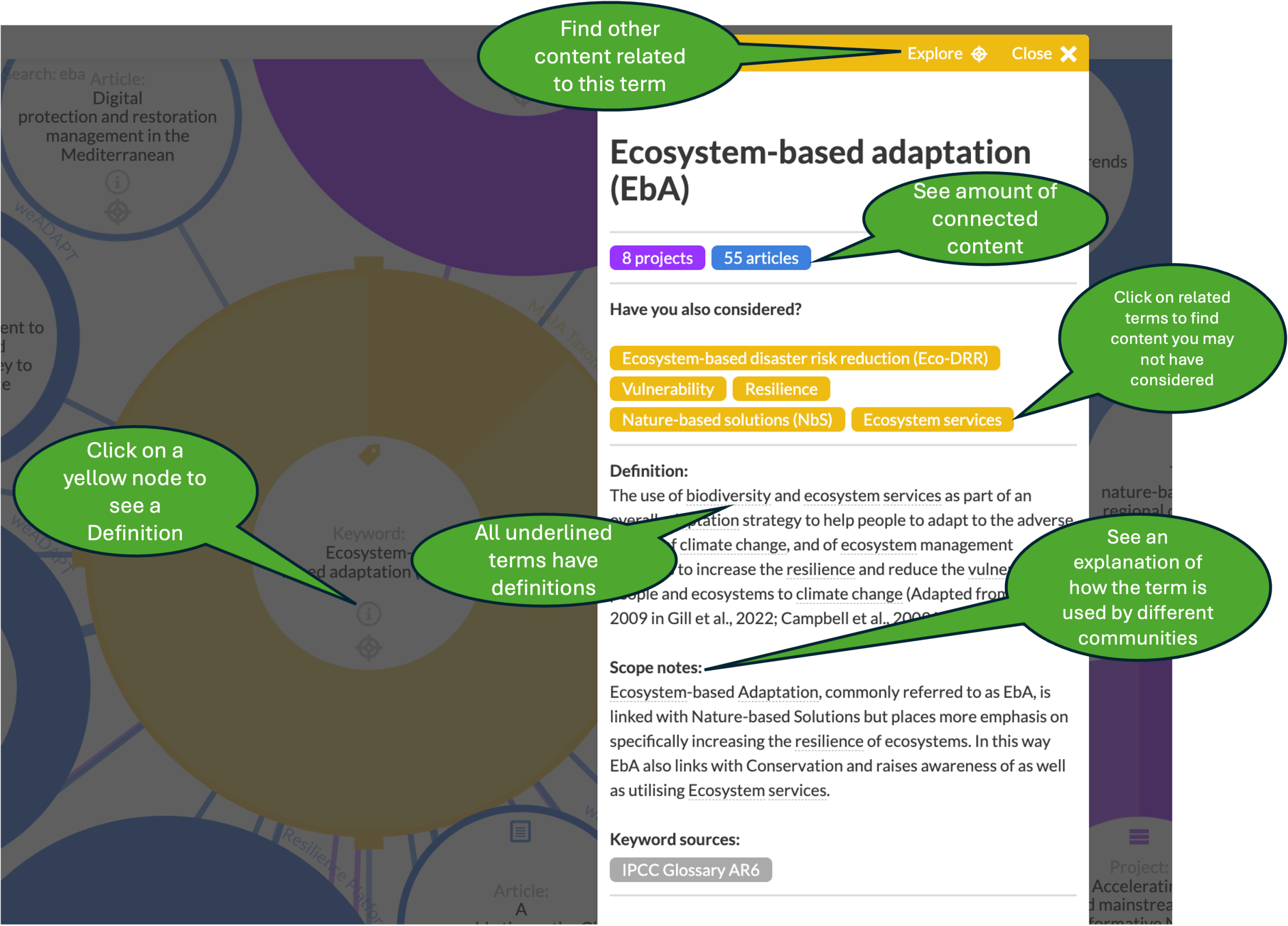
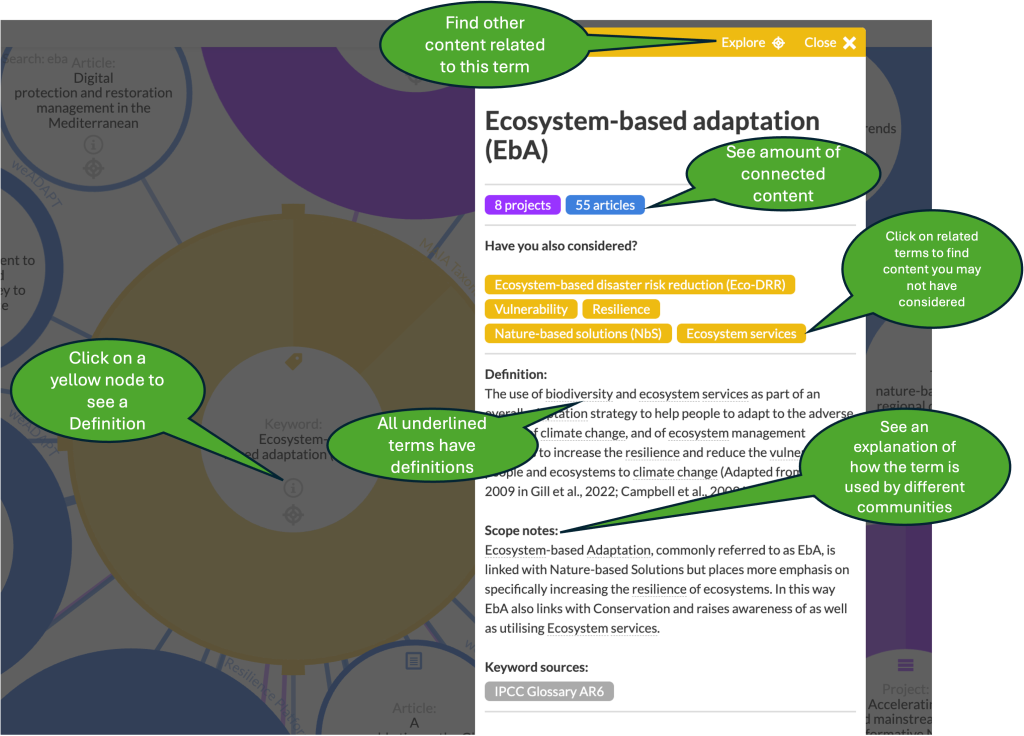
The CC Taxonomy is an AI- and human-curated collection of terms related to climate change and disaster risk. It powers the Climate Connectivity Hub—an online search and discovery tool that aggregates knowledge from platforms including weADAPT, CORDIS, PreventionWeb, Climate-ADAPT, and the Resilience Platform—making it easier for researchers, practitioners, and policymakers to find, connect, and build on existing work. It also powers an interactive glossary on the weADAPT global platform for adaptation, where hovering over a highlighted term shows the user the definition of the concept. This could be useful for other platforms and to increase interoperability between platforms. A dynamic listing of the taxonomy terms is also available.
“We don’t lack knowledge on climate adaptation. We struggle to connect it. In FAIR2Adapt, we are working to bridge these gaps across disciplines, communities, and platforms. The Climate Connectivity Taxonomy is a great example of how FAIR principles can help turn fragmented knowledge into knowledge that can be found, connected, and reused,” said Anne Fouilloux, FAIR2Adapt project coordinator and Chief Technology Officer at LifeWatch ERIC.
The taxonomy was built using robust, internationally recognized sources, including the glossary from the IPCC Sixth Assessment Report and the Hazard Information Profiles developed by the United Nations Office for Disaster Risk Reduction and the International Science Council. AI-assisted tools continuously harvest platform content to identify new terms, which human experts then verify before adding them to the taxonomy.
The scientific foundations of the taxonomy are detailed in a peer-reviewed article that was published in February 2026 in the journal Climatic Change, titled “Scaling knowledge interoperability for accelerated climate action through the Climate Connectivity Hub and Taxonomy” by Sukaina Bharwani, Kate Williamson, and Adam Wangrat (Stockholm Environment Institute and Neural Alpha). The article demonstrates how taxonomies can advance FAIR (Findable, Accessible, Interoperable, and Reusable) knowledge management for climate change adaptation platforms.
“Having worked on weADAPT, a global knowledge exchange platform for climate change adaptation, for almost 20 years, I was always frustrated by the inability of the many great knowledge platforms out there to work together and to connect their specialist knowledge to collectively build on their strengths. This inhibits the shared understanding and learning we need to address escalating climate and disaster risk challenges. Supporting interoperability between platforms is a step towards building on existing knowledge, instead of reinventing the wheel, enhancing peer-to-peer learning and accelerating climate action,” said Sukaina Bharwani, Senior Research Fellow at the Stockholm Environment Institute, Oxford Centre, and lead author of the study.
An open-access Application Programming Interface (API) for version 1 of the Climate Connectivity Taxonomy was released in June 2025, enabling any platform or tool to import the taxonomy and align its vocabulary with the Hub. In collaboration with the Horizon Europe Innovation Action, DIRECTED, the latest Hub update (August, 2026) includes more concepts to address existing data, communication, and governance gaps, as well as unique “scope notes,” which provide richer context for the use of the same term in different ways by different actors or disciplines. A “submit new concept” feature will soon allow users to contribute to the taxonomy’s ongoing development.
The Climate Connectivity Hub is curated and managed by the Stockholm Environment Institute (SEI) and is freely accessible at https://connectivity-hub.weadapt.org/. Learn more in this short video: https://www.loom.com/share/175adbdc442544b0b716e0128eb01dbc. Read the article in Climatic Change here: https://doi.org/10.1007/s10584-026-04139-y.